Lower Back Pain Physiotherapy: Treatment & Resolution
Lower back pain is rarely from a single episode, action, or event. Typically, there is a combination of movements, postures, and loads which have been acting on your spine for months or years. Effective lower back pain physio starts by identifying these movements, postures, and loads rather than just treating the pain at the end of the process.
What Lower Back Pain Physio Actually Involves
Physiotherapy for lower back pain is different to working with a single joint, like the knee. It needs to involve looking at the whole body; posture, motor control, joint mobility, and how load is distributed through the system during everyday tasks can all be critical. Fundamentally, the goal has to be to find the mechanical faults driving the pain episode, rather than just soothing discomfort.
If your pain is the result of a long and complex chain of events, then treating the muscle spasm causing your pain today won’t necessarily keep you out of pain in future. It won’t even necessarily help you tomorrow! But if we can come together to an understanding of the hidden drivers of your pain, then we can bulletproof you against future episodes. And by doing this efficiently and effectively we’ll still be able to relieve your pain today.
How a Physiotherapy Assessment Differs From a GP Visit
A GP visit for lower back pain usually focuses on ruling out serious issues and managing symptoms. Sometimes you will receive an onward referral for physio or medical imaging. And all of these can be helpful. But you won’t typically receive a thorough biomechanical assessment unless your GP is a specialist.
A physiotherapy assessment will always (hopefully!) go much further. It should include a review of your back pain history, as well as any other injuries you may have. It should review your movement habits (work posture, exercise, household and garden tasks), and there should be a component of provocative testing to work out what actually triggers your pain. Of course, if you are in a lot of acute pain then provocative testing might just be observation of you sitting in your chair in pain.
You should receive a specific diagnosis (whether tissue-based or mechanical) and specific advice on how to manage your pain. If you do not leave with a clear understanding of the movements, postures, and loads that trigger your pain and a roadmap to avoiding them, then the assessment has failed.
Common Causes of Lower Back Pain in Office Workers
Working at a desk does not cause lower back pain. However, it does create a set of conditions which can set you up for difficulties depending on your anatomy and your activities outside work.
If you love road cycling and deadlifting and work a desk job then you need to understand that all three of these activities involve loading the spine in flexion. This means that you need significant flexion tolerance in order to continue doing all three without pain. Is it possible to build this tolerance? Absolutely! But it needs to be a conscious, deliberate decision with a clear plan.
Sedentary Posture and Spinal Loading
We don’t always think of sitting as loading, but it is! Sitting for extended periods involves sustained flexion of the spine under load. Think of a deadlift: even if you keep your back as ‘locked’ as you can, there is a small amount of spine flexion involved. This can even be beneficial for building capacity! But the movement lasts a few seconds at most. When sitting, we are typically exposed to more spine flexion than a deadlift and we may be exposed to that load for hours at a time! So even if the load is less, the cumulative load is greater.
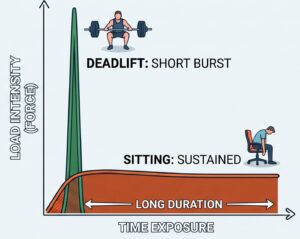
If your spine has become sensitised to this loading, the pain oftern doesn’t show up during the sitting period itself but later in the day, the next morning, or even at the gym later in the day!
Hypermobility and Recurring Flare-Ups
Crucially, the example above is just that: ONE example. A skilled lower back pain physiotherapy assessment does not stop at, “you sit for work so naturally you have pain.”
A thorough lower back pain physio assessment should screen for and adjust for spinal hypermobility, underlying health conditions, recent or chronic illnesses, not to mention your particular goals.
Why does this matter? In the hypermobility example the same stretches that help to relieve the acute back pain of an ‘average’ office worker may send the hypermobile person further into their pain. And the worst part is, the stretches will likely feel good at the time so the patient and clinician can both remain clueless that the treatment was what worsened the problem!
What to Expect From a Lower Back Pain Physio Session
Your assessment will move through a few clear stages: history taking, assessment of triggering movements, postures, and loads, hands-on testing, and treatment either via exercise, passive treatments, or both. The structure is more important than the actual techniques or modalities. Two clinicians may both apply dry needling for symptom relief, but if one understands the underlying cause and the other does not, then the outcomes can be very different.
This point bears repetition: if you leave without a clear understanding of the movements, postures, and loads which trigger your pain and a roadmap to recovery, then the session has failed.
Mobile Assessment vs Clinic Visit
I offer both clinic sessions and mobile physiotherapy. And both have their advantages.
A clinic visit removes you from many of the distractions of your home and lets you focus on recovery. It is also more convenient for me as a clinician in many ways!
A home visit, mobile physiotherapy, lets us observe you in your natural environment and do a thorough audit of things like your home office set-up, your mattress, your pillow, the arrangement of your kitchen or garden. We can see, and often correct, the ways your life is organised which keep you in pain!
Movement-Based Approaches to Recovery
There is a lot of complexity around lower back pain, but one thing we know for certain is that rest has only limited value. After a few days at most, recovery is more about maximising activity (in safe and progressive ways) than about bed rest.
And the same goes for ‘passive’ treatments like massage and dry needling. These can be fantastic for managing your symptoms and opening up your capacity for pain-free movement. But it’s that movement that creates the lasting change.
Building Movement Resilience With Strength and Mobility Work
I am approach-agnostic to a fault. By this I mean that if you tell me that the movement activity that gives your life meaning is to dance Tango then that is what we are going to work towards and that may even be what we structure your rehab around. If you’re a dancer, we’ll dance. If you’re a martial artist, we’ll work with that. Hate dry needling? I do cupping as well. Whatever path makes sense for your injury, your body, your history, and your goals, that is the path we will take together.
Nothing generic, no fixed ideas about what constitutes ‘good’ exercise, just collaboration to find you a pathway to recovery.
Self-Guided Recovery When In-Person Physio Isn’t an Option
Not everyone has access to high-quality care close to home. Though if you’re located in Gungahlin or North Canberra then you absolutely do and you should look into my mobile physiotherapy service!
If you’re outside this service area and still want to work with me then send me a message. You can also check out my Back Pain Foundations online program which helps guide you to understand your pain through guided testing and then walks you through movement tools and exercise progressions to rebuild your pain-free capacity. The program is built around the same principles as my in-person work but gives you greater flexibility. Not to mention you can access the program from anywhere in the world!
Who the Back Pain Foundations Course Is For
The course suits people with recurring or chronic lower back pain who want a structured way to work through identifying the cause of their pain, develop movement tools to help live a more comfortable and powerful life, and rebuild their capacity for life and activity free from worrying about pain. It is not designed to help you through severe acute episodes and cannot diagnose or treat serious pathology, fractures, and the like.
When to See a Physiotherapist for Lower Back Pain
Lower back pain is one of the most common complaints for which people seek treatment. It can cost you days at work, it can cost you your season on the football field, and it can even affect your ability to play with your children!
If your pain persists beyond a few days or weeks, recurs repeatedly after periods of relief, or causes you to alter your normal movement habits to avoid pain, it’s time to seek professional help.
If you’re in Gungahlin or North Canberra, a mobile in-home assessment can help you to identify the drivers of your pain and start working towards of a solution. For those outside that area who want a structured, self-guided approach, check out the Back Pain Foundations online course.